Destinations
China Travel Month by Month: Best Places to Visit in 2026
A practical China travel calendar for first-time visitors: where to go each month in 2026, with weather, crowds, holiday timing, route difficulty, and arrival-prep notes.
Quick Answer
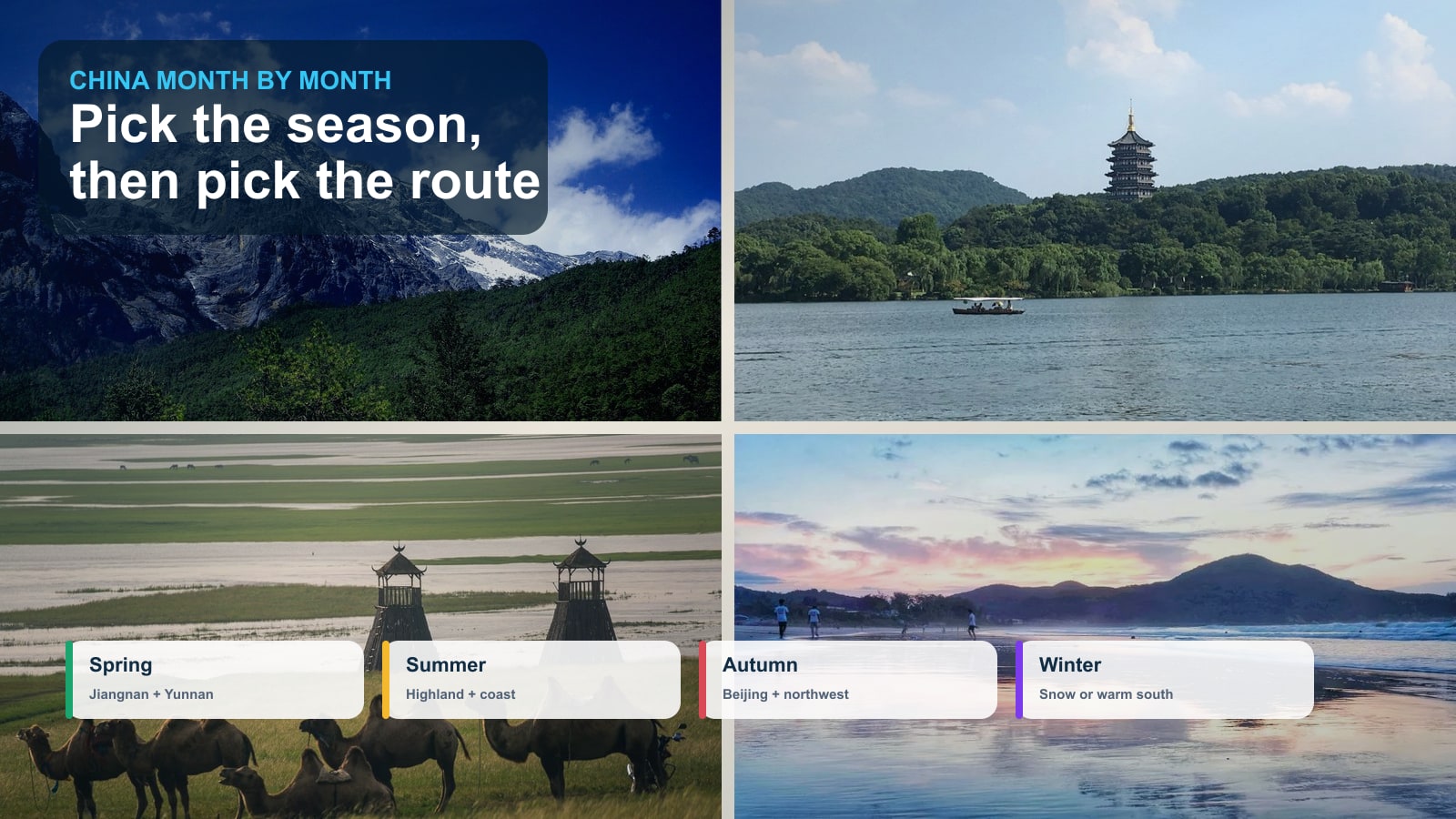
The best month to visit China depends on the route. January and February are best for Harbin-style winter travel or a warm-south route in Yunnan, Hainan, Guangdong, or Fujian, but Spring Festival can complicate transport. March and April suit Hangzhou, Shanghai, Jiangnan, and Yunnan spring routes. May and June are good for Qingdao, Shandong coast, Guizhou, and Yunnan before peak summer heat. July and August should focus on cooler-feeling highlands, waterfalls, grasslands, or coast, not all-day megacity sightseeing. September and October are excellent for Beijing, Xi'an, Gansu, Hangzhou, and Jiuzhaigou-style autumn routes, but avoid the October 1 holiday rush when possible. November and December work well for quieter cities, warm southern routes, and early winter planning.
Best Option by Scenario
| Scenario | Best option | Notes |
|---|---|---|
| First China trip with no fixed month | Choose April-May or late September-November for the easiest balance of weather, cities, food, and transport. | Avoid assuming October is easy: the National Day holiday period can make major routes crowded and expensive. |
| You can only travel in July or August | Use Yunnan highlands, Guiyang/Guizhou, Qinghai/Gansu, Hulunbuir, or the Shandong coast. | Treat summer as a climate strategy, not a sightseeing checklist. |
| You want winter scenery | Choose Harbin for ice and snow, or split winter between a cold north highlight and a warm-south reset. | Festival dates, opening windows, and hotel prices can shift; verify the current season before booking. |
| You want slow travel or a longer stay | Base yourself in Yunnan, Hangzhou, Shanghai, Guangzhou, Xiamen, or Chengdu-style city regions depending on season. | For longer stays, prioritize weather comfort, apartment/hotel acceptance, payment setup, and rail access over chasing every famous landmark. |
Detailed Guide
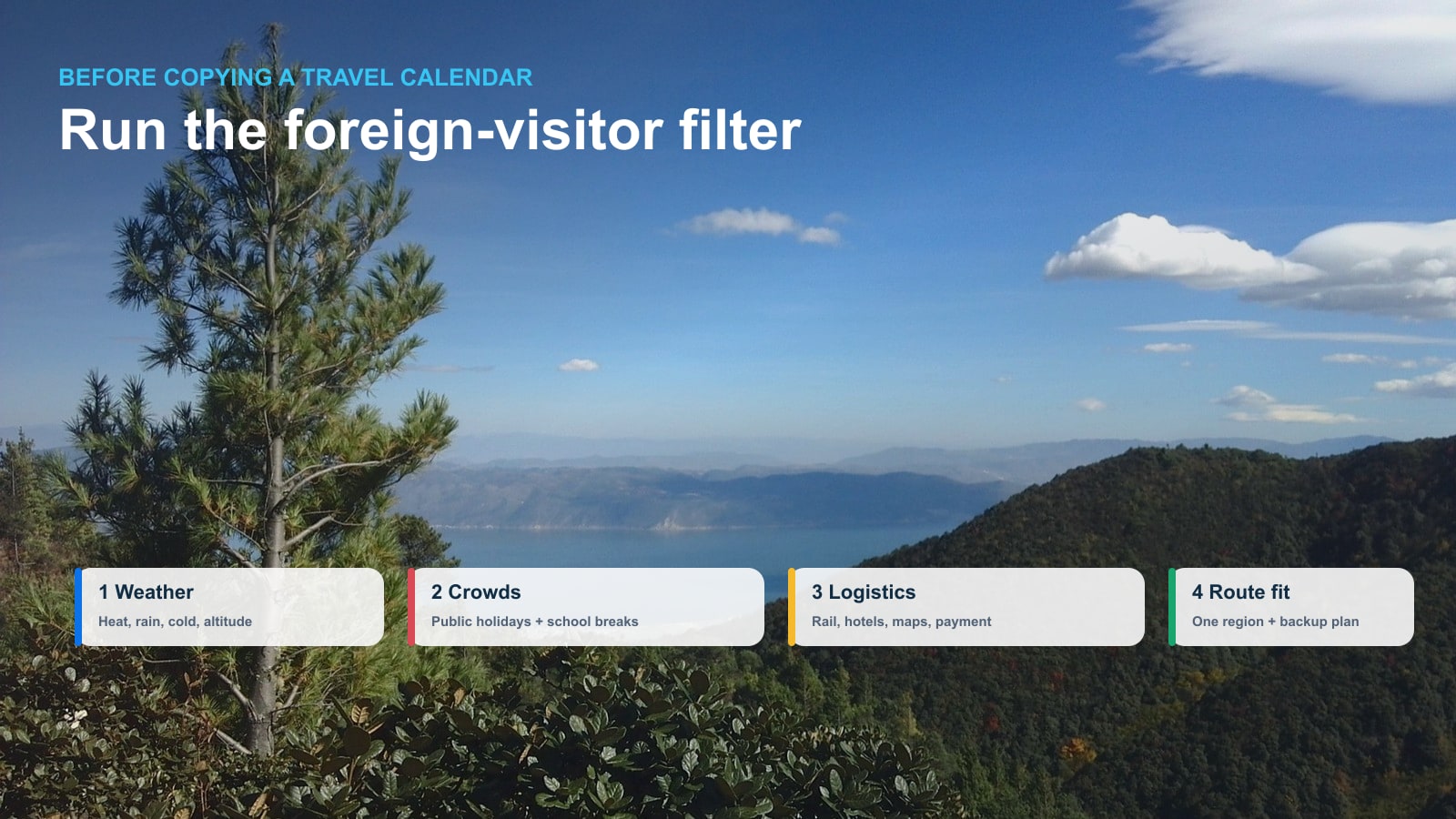
A useful China month-by-month plan starts with filters, not with a romantic list of places. The Xiaohongshu-style domestic calendars Steven shared are strong topic inspiration because they show how Chinese travelers think: match a month to flowers, snow, coast, heat escape, autumn leaves, or slow-living city time. For a foreign visitor, the calendar needs one extra layer: whether the month still works after weather, crowds, train tickets, payment setup, maps, hotel addresses, and language friction are included.
January To June
January and February are split months: go north for Harbin-style ice and snow, or go south and southwest for milder weather in Yunnan, Hainan, Guangdong, or Fujian. Spring Festival can make this period hard, so the safest winter plan is either a clear seasonal goal or a slower warm-south route. March and April are the easy spring months for Hangzhou, Shanghai, Suzhou, Wuyuan-style countryside, and Yunnan. May and June are good for Qingdao, the Shandong coast, Guizhou, and Yunnan before peak summer heat fully takes over.

Spring City Routes
For a first China trip, March to May is often the cleanest window because classic city routes become easier: Hangzhou and West Lake, Shanghai neighborhoods, Beijing before deep summer, Guangzhou food routes, and Yunnan highlands can all work with fewer weather extremes. The trade-off is holiday timing. Qingming and May Day can still create crowd spikes, so the best spring plan leaves room for flexible mornings, booked attractions, and a backup indoor block.

July To August
July and August are not months for copying a general “China must-see” list. They are months for choosing a climate strategy. Use Kunming, Dali, Lijiang, Guiyang, Guizhou waterfalls, Qinghai, Gansu, Hulunbuir, or the Shandong coast if your goal is to make summer feel manageable. Beijing, Shanghai, Xi’an, Chengdu, Chongqing, Guangzhou, and Hong Kong can still be part of a trip, but they need early starts, indoor midday plans, fewer transfers, and honest rest.
September To December
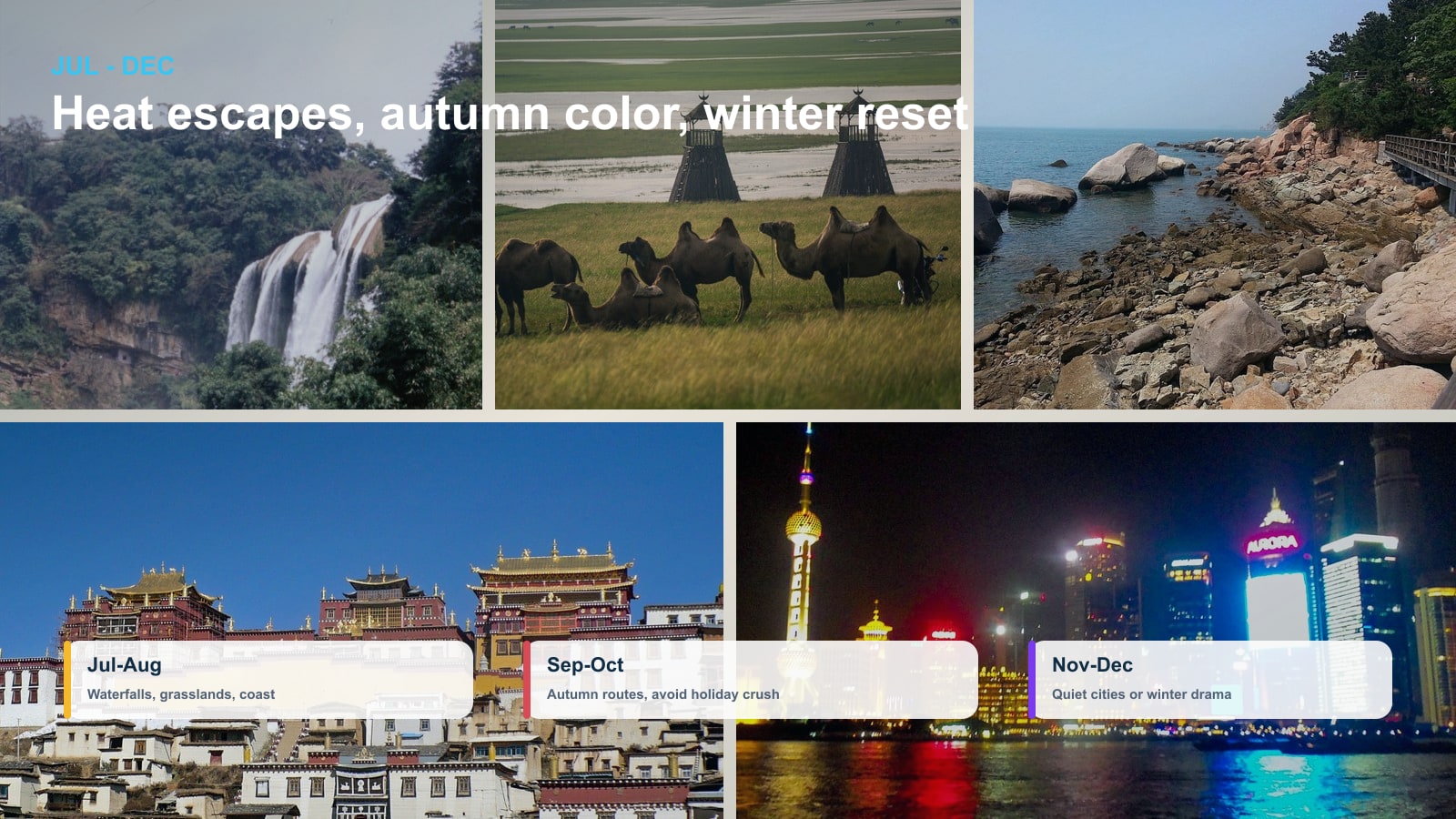
September to November is the other strong first-trip window. Beijing autumn, Xi’an, Gansu, Hangzhou, Shanghai, and Sichuan or Jiuzhaigou-style autumn scenery can be excellent, but October 1-7 is the danger zone for crowds and prices. December is a split again: Harbin begins to matter for winter planning, while Yunnan, Hainan, Guangdong, Fujian, Shanghai, and Guangzhou can work for quieter city travel or a softer-weather route. The right late-year plan depends on whether you want winter drama or comfortable movement.

How To Use This Calendar
Pick one anchor month, then choose one region and one backup strategy. If the month is hot, choose highland, waterfall, grassland, or coast. If the month is cold, choose either winter scenery or warm south, not both unless you have enough time and luggage space. If the month overlaps a Chinese holiday, reduce the route rather than adding more stops. The best annual travel calendar is not the one with the most destinations; it is the one you can actually enjoy after trains, hotels, weather, maps, and payment are working.
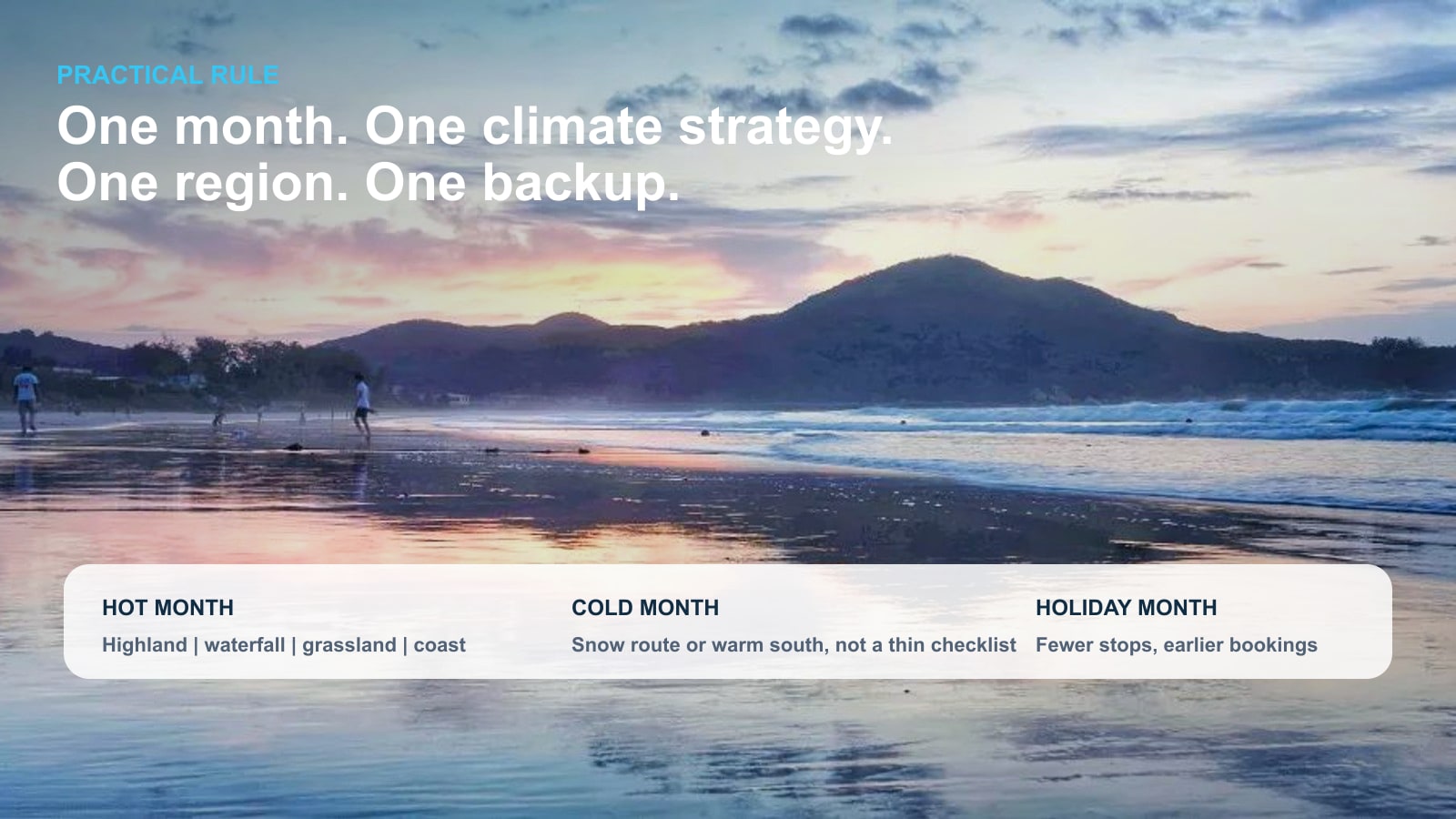
Image Credits
The month-by-month seasonal graphics were created by Siye China as local raster JPG assets from existing Siye China destination-photo assets. Destination photos are existing Siye China licensed or credited assets used across the Yunnan, Hangzhou, Shantou, Qingdao, Shanghai, and summer-destination guides.
Step-by-Step Checklist
- 1Pick the month before the city listA domestic travel calendar is useful inspiration, but foreign visitors should filter it by weather, crowd pressure, and logistics.
- 2Check Chinese public holidaysSpring Festival, May Day, summer school holidays, and National Day can change train tickets, hotel prices, attraction booking, and crowd levels.
- 3Match the route to your tolerancePlateau, grassland, coast, winter, and megacity routes each require different clothing, pacing, and backup plans.
- 4Prepare arrival tools before regional travelSet up payment, maps, translation, rail booking, DiDi, hotel addresses in Chinese, and backup connectivity before moving between provinces.
Common Mistakes
- Copying a Chinese domestic month-by-month list directly. Keep the destination ideas, then remove options that are too hard for your first China trip, your heat tolerance, or your app/payment setup.
- Treating October as automatically the best month. Late October and November can be excellent, but the October 1 holiday period needs avoidance or careful booking.
- Planning summer around famous cities only. In July and August, build around highland, waterfall, grassland, or coast routes, then add indoor city time sparingly.
- Ignoring winter transport and clothing. Harbin and the northeast need serious cold-weather preparation; warm-south routes still need rain and holiday checks.
FAQ
What is the best month to visit China?
For most first-time visitors, April-May and late September-November are the easiest windows because weather is usually more comfortable and many classic city routes work well. The best month still depends on your region, crowd tolerance, and holiday timing.
Is October a good month to visit China?
October can be excellent after the National Day holiday rush, especially for Beijing autumn, Gansu, Hangzhou, and Jiuzhaigou-style scenery. Avoid or book very carefully around October 1-7 because transport and attractions can be crowded.
Where should I go in China in July or August?
Choose cooler-feeling routes such as Yunnan highlands, Guiyang and Guizhou, Qinghai or Gansu, Hulunbuir grasslands, or the Shandong coast. Do not plan all-day outdoor sightseeing in hot megacities without indoor recovery blocks.
Is winter a bad time to visit China?
No. Winter can be great for Harbin ice and snow, Yunnan, Hainan, Guangdong, Fujian, and quieter city trips. The trade-offs are cold-weather gear, Spring Festival movement, shorter daylight, and shifting opening dates for seasonal attractions.
Should first-time visitors copy a domestic Chinese travel calendar?
Use it as inspiration, not as a finished itinerary. Domestic lists often assume Chinese apps, language, payment habits, school-holiday timing, and tolerance for dense crowds that foreign first-time visitors may not share.
Sources and Update Notes
- User-provided Xiaohongshu annual China travel calendar Steven provided this on June 4, 2026 as Chinese demand and topic inspiration for month-by-month domestic travel planning. It is used as demand signal, not as a factual source for weather, access, or prices.
- User-provided Xiaohongshu slow-travel timetable Steven provided this on June 4, 2026 as slow-travel and longer-stay inspiration. It is used to shape reader intent, not as proof of current logistics.
- User-provided Xiaohongshu July-August cool-city list Steven provided this on June 4, 2026 as summer heat-escape inspiration, including visible references to Kunming and cool-city framing.
- User-provided Xiaohongshu month-by-month destination list Steven provided this on June 4, 2026 as annual travel timetable inspiration.
- Shangri-La | Visit Yunnan Checked on June 4, 2026 for Yunnan plateau seasonality, elevation context, and highland route caution.
- Guiyang Public Transport expands summer travel services Checked on June 4, 2026 for Guiyang summer travel-service context and cool-climate positioning.
- Beijing's Picturesque Autumn Scenery Set to Unfold Checked on June 4, 2026 for Beijing autumn foliage timing and official autumn-route framing.
- Hainan's multi-directional efforts to attract visitors Checked on June 4, 2026 for Hainan winter tourism positioning.
- AP: An annual ode to ice is carved in frozen northern China Checked on June 4, 2026 for Harbin ice-and-snow travel context and seasonal caution; travelers should verify current official opening dates before booking.
- China's public holidays for 2026 Checked on June 4, 2026 for official 2026 public-holiday timing and National Day crowd cautions.