Provider Analysis
Nomad China eSIM: App-Access Claims to Check for Tourists
A transparent, not-field-tested Nomad China eSIM buying analysis focused on app-access claims, VPN-like routing language, data-only tradeoffs, network context, and test gaps.
Quick Answer
This is a buying analysis, not a hands-on speed test. Nomad is worth comparing for China because its official help page directly addresses blocked services and says its China eSIM can access apps such as Google, WhatsApp, Facebook, Gmail, and YouTube without an external VPN. That is a stronger China-specific claim than generic "travel data" copy, but it still needs careful reading: Nomad also says the eSIM does not encrypt data like a traditional VPN. Before buying, verify the current plan page, data amount, activation behavior, hotspot terms, route coverage, and whether data-only service fits your trip.
Best Option by Scenario
| Scenario | Best option | Notes |
|---|---|---|
| Your main concern is Google, WhatsApp, or Gmail access | Read Nomad's China help page first, then compare the exact plan terms. | Nomad makes explicit app-access claims, but this page has not field-tested them. |
| You want network context | Check Nomad's listed China network information and route coverage. | Network labels help, but they are not a city-by-city coverage guarantee. |
| You need VPN encryption | Do not treat Nomad's eSIM as a traditional VPN replacement. | Nomad says its functionality is VPN-like but does not encrypt data in the same way. |
Detailed Guide
Nomad is not interesting because it is another eSIM brand. It is interesting because its official help content directly addresses the China question most travelers care about: whether blocked services and common international apps can work without a separate VPN.
This page is not a hands-on review. We did not buy a Nomad China plan, install it on a device, and test Google, WhatsApp, Gmail, YouTube, speed, or latency inside China. The value here is narrowing what to verify before purchase.
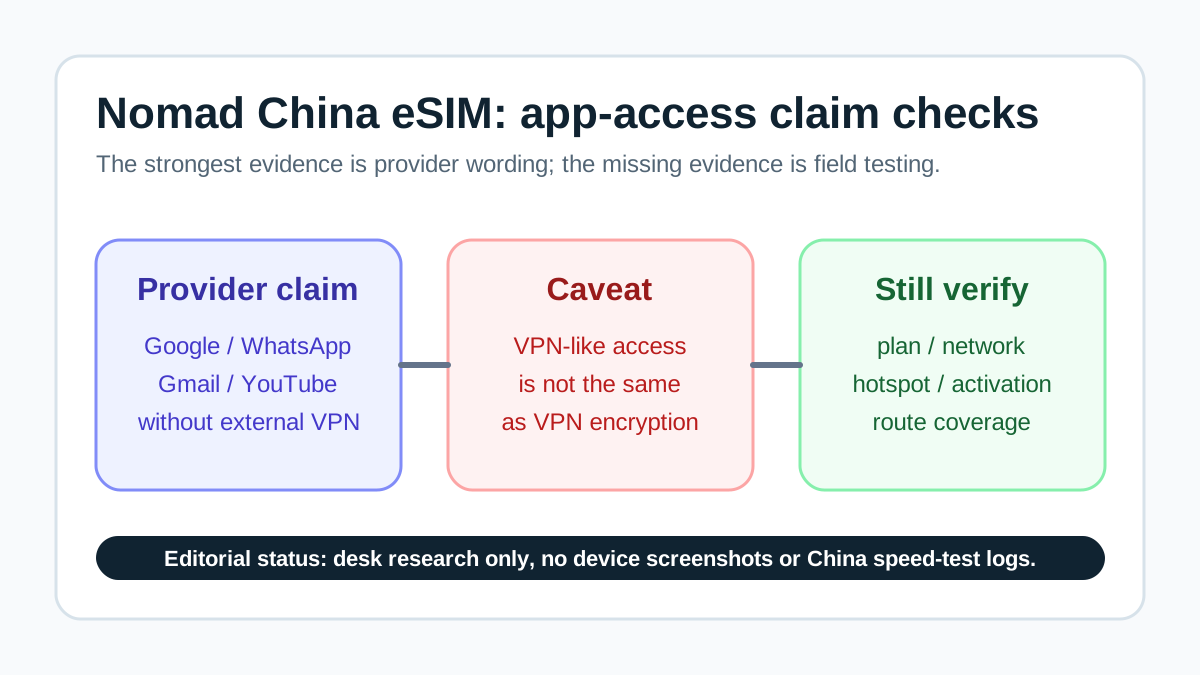
Nomad’s differentiator is the app-access claim; the caveat is that access and VPN-grade encryption are not the same thing.
Evidence Level
| Evidence type | What we have | What we do not have |
|---|---|---|
| Official terms | Nomad help content explicitly discusses blocked services, no external VPN, and traditional-VPN encryption caveats. | A private support confirmation for a specific plan after checkout. |
| Plan context | Nomad’s public China plan page includes setup flow, network context, and customer-review surfaces. | Independent lab measurements or city-by-city tests. |
| Hands-on test | None. | No app screenshots, speed tests, or reliability logs. |
The App-Access Claim Is the Main Reason to Read Nomad
Nomad’s help page says its China eSIM gives access to blocked services such as Google, WhatsApp, and Facebook without an external VPN, and describes international-server routing. That is the clearest China-specific provider claim among the three pages in this sprint.
The same help page also says the eSIM does not encrypt data in the same way a traditional VPN would. That distinction matters. If your goal is access to apps, Nomad’s claim is relevant. If your goal is VPN-grade privacy and encryption, you should not treat the eSIM as a complete VPN substitute.
What to Check on Nomad Before Buying
| Nomad check | Why it matters |
|---|---|
| Help-page date and wording | China access language can be strategically important and should be current. |
| Exact plan data amount | App access does not help if you run out of data. |
| Listed network context | Useful for expectation-setting, but not a coverage guarantee. |
| Activation behavior | You need to know whether validity starts on purchase, install, or first destination connection. |
| Hotspot and top-up | Relevant for laptop work, family travel, and longer stays. |
How Nomad Differs From Saily and Airalo
Nomad’s page should be read by travelers whose first concern is app access. It makes the most direct public claim about blocked services among these three providers.
Saily should be read by travelers who care about predeparture app setup, top-up, hotspot, and the site’s affiliate path.
Airalo should be read by travelers comparing marketplace-style local and regional plans across multiple countries.
Practical Verdict
Shortlist Nomad if app access is your main buying anxiety and you want to read a provider’s China-specific explanation before paying. Do not use this page as proof that Nomad will be fastest, cheapest, or most reliable in every Chinese city.
For the broader decision, read the best eSIM for China guide. If you are still comparing eSIM against local SIM and roaming, start with eSIM vs local SIM vs roaming.
Step-by-Step Checklist
- 1Read Nomad's China app-access help page.This is Nomad's most distinctive China-specific evidence.
- 2Separate access from encryption.Nomad discusses access to blocked services, but says it is not the same as traditional VPN encryption.
- 3Check current network and route coverage.Useful if your route includes smaller cities, transit days, or nearby regions.
- 4Verify hotspot, activation, and top-up.These determine whether the plan fits real travel behavior.
Common Mistakes
- Treating Nomad's app-access claim as a speed-test result. Use it as a provider claim to verify, not as proof of performance in every city.
- Assuming VPN-like access equals VPN security. Nomad says its eSIM does not encrypt data in the same way a traditional VPN does.
- Skipping route checks because the plan says China. Check whether your full trip includes mainland China only or also Hong Kong, Macao, Taiwan, or other Asia stops.
FAQ
Did Siye China test Nomad in China?
No. This page is a desk-research buying analysis based on Nomad's official China help content, its plan page, device guidance, and traveler-demand research.
What makes Nomad different from Airalo and Saily?
Nomad's main difference is explicit China app-access language. Airalo is more marketplace-oriented, while Saily has clearer app setup and affiliate flow on this site.
Does Nomad replace a VPN?
Not fully. Nomad says its China eSIM can provide access to restricted services without an external VPN, but also says it does not encrypt data like a traditional VPN.
Is Nomad the safest recommendation?
Not without testing. It is the clearest page to read if app access is your top concern, but the exact plan and your device still matter.
Sources and Update Notes
- Nomad Help Center: stay connected in China with Nomad eSIM Checked for Nomad's explicit app-access and VPN-like routing language.
- Nomad China eSIM plan page Checked for network context, setup flow, and plan positioning.
- Apple Support: using eSIM with iPhone in China mainland Checked for device and regional eSIM caveats.
- Audience research brief: eSIM review sprint Reddit and YouTube were used as demand signals only, not factual proof.